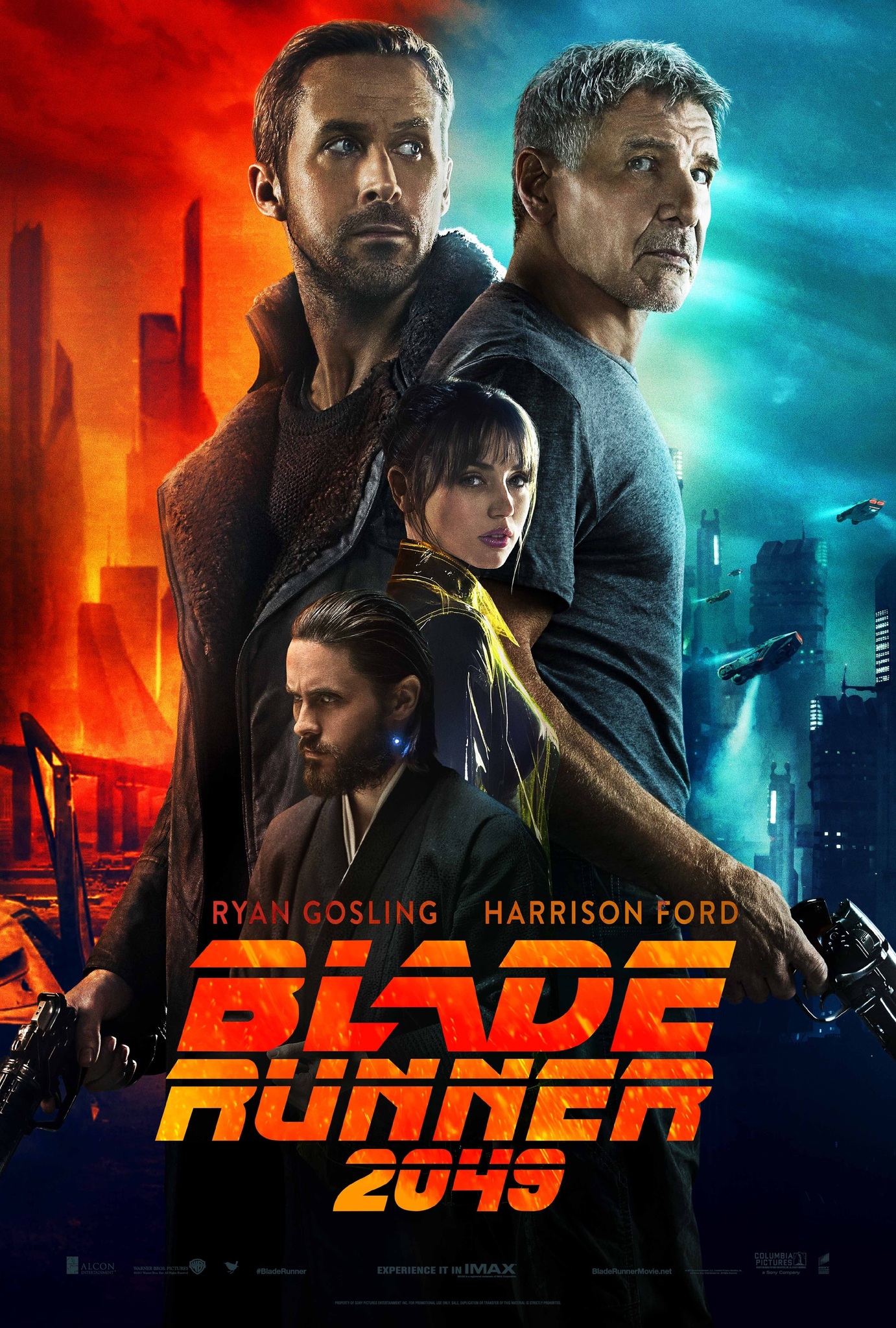
Blade Runner 2049
| Genre | Drama |
| Laufzeit | 164 Minuten |
| Ton | |
| Dolby Atmos | |
| Auro 11.1 | |
| DTS | |
| IMAX 6-Track | |
| 12-Track Digital Sound | |
| Dolby Surround 7.1 | |
| Sonics-DDP | |
| Budget | 0 $ |
| Erscheinungsdatum | |
| USA: 03.10.2017 | |
| Germany: 05.10.2017 | |
| USA: 06.10.2017 | |
| Websites | |
| Official Facebook | |
| Official Instagram | |
| Official Site | |
| Official Site [France] | |
| Official Twitter | |
Beschreibung
A young blade runner's discovery of a long-buried secret leads him to track down former blade runner Rick Deckard, who's been missing for thirty years.At Cinemas Now
'Blade Runner 2049' Trailer With Director's Commentary
At Cinemas October 5
International TV Spot #1
Trailer #2
Official Trailer
Teaser Trailer
Regisseur
Denis Villeneuve
((directed by))
Schauspieler
Ryan Gosling
('K')
Dave Bautista
(Sapper Morton)
Robin Wright
(Lieutenant Joshi)
Mark Arnold
(Interviewer)

Vilma Szécsi
(Angry Old Lady)

Ana de Armas
(Joi)
Wood Harris
(Nandez)
David Dastmalchian
(Coco)
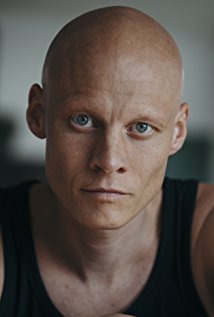
Tómas Lemarquis
(File Clerk)

Sylvia Hoeks
(Luv)
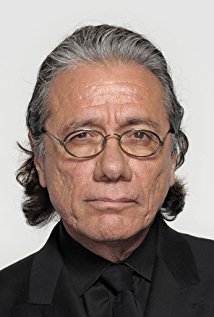
Edward James Olmos
(Gaff)
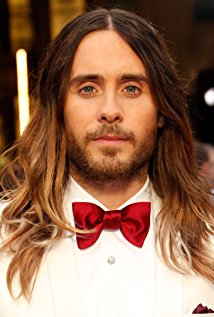
Jared Leto
(Niander Wallace)
Sallie Harmsen
(Female Replicant)
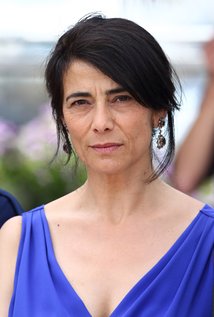
Hiam Abbass
(Freysa)

Mackenzie Davis
(Mariette)
Krista Kosonen
(Doxie #2)

Elarica Johnson
(Doxie #3)
André Lukács Molnár
(Memory Child)
István Göz
(Scavenger #1)
Pál Nyári
(Scavenger #2)
Joshua Tersoo Allagh
(Scavenger #3)
Zoltán Béres
(Scavenger #4)
Konstantin Pál
(Scavenger #5)
Ferenc Györgyi
(Scavenger #6)
Samuel Brown
(Orphanage Boy)
Lennie James
(Mister Cotton)
Carla Juri
(Dr. Ana Stelline)
Kincsö Sánta
(Birthday Girl)
Barkhad Abdi
(Doc Badger)
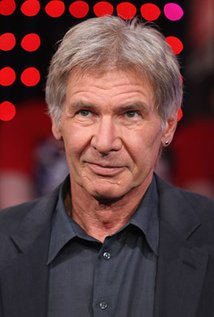
Harrison Ford
(Rick Deckard)
Ben Thompson
(Elvis Look-A-Like)

Suzie Kennedy
(Marilyn Look-A-Like)
David Benson
(Liberace Look-A-Like)
Stephen Triffitt
(Sinatra Look-A-Like)

Sean Young
(Rachael)
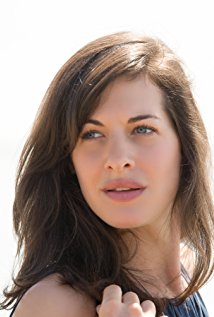
Loren Peta
(Rachael Performance Double)
Bernie Leinfelder
(Japanese Computer)

Kingston Taylor
(Boy with One Ear)
Yale Badik
(executive producer)
Dana Belcastro
(co-producer)
Bill Carraro
(executive producer)
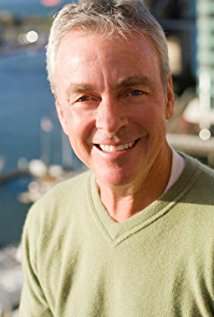
Tim Gamble
(executive producer)
Frank Giustra
(executive producer)
Asa Greenberg
(co-executive producer)
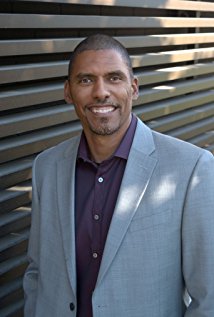
Val Hill
(executive producer)
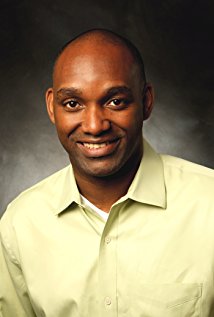
Broderick Johnson
(producer (produced by))
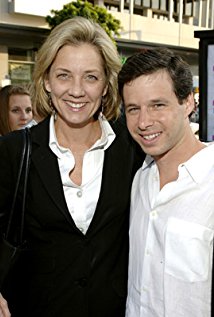
Andrew A. Kosove
(producer (produced by))
Ian McGloin
(co-executive producer)
Carl Rogers
(co-producer)
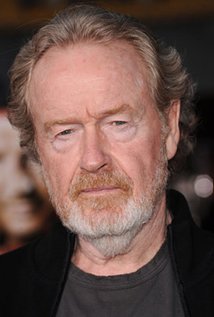
Ridley Scott
(executive producer)
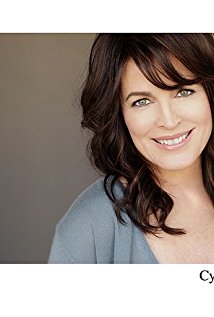
Cynthia Sikes
(producer)
Donald Sparks
(associate producer)
Steven P. Wegner
(co-producer)
Bud Yorkin
(producer (produced by))
Michael Green
((screenplay by))
Hampton Fancher
((story by))
Benjamin Wallfisch
((music by))
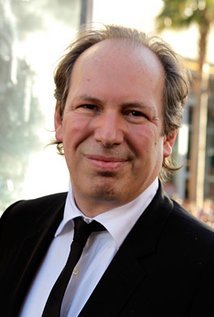
Hans Zimmer
((music by))
Verrücktes
There are no opening credits.The opening logos are in black and white, with each of them eventually glitching out and being back-lit by a bright light.Fehler
Audio/visual unsynchronised
While exploring the abandoned casino, K gives a casual one-handed spin to a roulette wheel. The soundtrack adds the rattling noise of a roulette ball (or pill) landing in a pocket, even though K clearly does not pick up a ball or launch one.Only about two-thirds of the wheel is seen before K spins it, so the ball could have been sitting in the non-visible third ; and the camera quickly cuts away, so it could not be seen flung out and spinning.
However, this cannot be so since a roulette wheel is designed such that a ball does not simply sit there, but will naturally roll into a number pocket, even if the wheel is stationary. And if the wheel is then casually spun, the ball is not flung out but will remain trapped in its pocket. This behavior of the ball is required to show that the wheel is not rigged.
And furthermore, the Accidentally Flung Ball scenario is not seen to happen in the "Time to Live" featurette, which has a longer shot of this scene where the camera doesn't cut away.
Continuity
The back of K's jacket gets dirty during the fight before reaching the orphanage and then is completely clean when inside the orphanage.Continuity
When Deckard locks the door and runs to where his Spinner is parked, the position of his dog relative to him changes between shots. First, the dog is ahead of him when he locks the door, then behind him as Officer K bursts through the wall, then the dog vanishes when the Spinner explodes.Continuity
After the scene where K finds the wooden horse inside the furnace, we cut to Joi and K back at their apartment. During their conversation, Officer K's arms change position, from resting on his lap, to his clenched fists being used to support his chin, between shots.Continuity
In Sapper Morton's kitchen, in the wide shots at the start of the scene, the flame under the pot is on full . Later, when the pot is in the foreground, the flame is much lower. At the end of the scene, as K opens the lid and smells the garlic, the flame is medium-high.Continuity
When K is at Dr. Ana Stelline and he kicks the stool over, you can see the reflection of Ana sitting straight and looking to the left at the stool. When the camera pans over to her again, you still see her sitting hunched over and crying.Continuity
When Officer K says to Deckard, "Look, I don't want to hurt you..." he is extending his right arm towards Deckard. In the next shot when K says "... but you're not making it easy." his left arm is extended towards Deckard, with his right arm resting at his side.Factual errors
During the test clip shown of Rachel, supposedly some of the only data on her had by Wallace, we are clearly shown that her eyes are green. Yet when they attempt to tempt Deckard by an exact copy of her, they seem to fudge up this detail. This is a mistake by, or a technical shortcoming of, the Wallace Corporation ; which was noticed by Deckard. It isn't a plot-hole goof by the film-makers.Factual errors
We see a number of bee hives and agent K's hand covered with bees. However the area is devastated, there is no sign of other life and certainly no flowers from which the bees can harvest nectar.Factual errors
In the final scene where Deckard is being taken to see Ana, the flying car lands in the snow - and leaves tire tracks. Even if the "flying" car drove there, it has a large central rear wheel (A 'reversed trike') and should have left three tire tracks, not two.Miscellaneous
When K meets the 3 hookers, there are lots of foreign language ads all around, one of them is for Coca Cola but in Hebrew. The letters flash on and off and then light each letter individually. The order in which they light up is left to right, and not as it should be, since it's Hebrew, right to left.Miscellaneous
The first song listed ("Summer Wind"), is displayed as "Perfromed by Frank Sinatra" instead of "Performed by Frank Sinatra".Miscellaneous
After the orphanage, K and Joi are back in his apartment having a conversation. At one point while they are talking K yells "stop!" at Joi and his breath makes Joi's hair move. Joi is supposed to be a hologram. Her hair shouldn't have been affected.Incorrectly regarded as goofs
At the end of the film when K leans back against the steps, you can see an indention in the snow where his elbow is about to be placed, leading one to believe that this is a continuity error and that the indentation is from a previous take. However, if you look as he sits down, he places his hand on the step to lower himself down, creating the indentation where his elbow will later rest.Incorrectly regarded as goofs
The Memory Bearings are optical devices, so how were they affected by the Blackout of 2022, which was caused by an electro-magnetic pulse ? The memory bearings are read optically, but we can only guess how they are written, and edited ; a punched card is also read optically, but it would be "edited" by a shotgun, and "erased" by a rainstorm.Incorrectly regarded as goofs
When Sapper Morton is in the pool checking on his grubs, it doesn't look like they could swim, so they'd all be on the bottom of the pool and he would be crushing them under his boots as he walked. It would be easy enough for the pool to have a metal grid, supported a few inches off the bottom ; on which he could walk., but reach through for the grubs.Incorrectly regarded as goofs
When Luv takes K to the room where the data files are stored, the heavy door jams about half way when opening. She then uses physical strength to open it with her hands (with no apparent effort), but she is wearing elegant shoes with heels on a slippery floor. It would be physically impossible for her to apply enough force on the heavy door to open it without having a good grip on the ground, regardless of her superhuman strength. She would normally slide away when trying. This being 2049, with advances in technology prompted by decades of litigation and compensation ; we can safely presume that such shoes have a means to "grip" at least artificial floors. That would be a trivial technical problem, compared to other portrayed technology : hover-cars, holograms that can see, instant showers, off-world travel, replicants etc. etc.Continuity
When Deckard is struggling to free himself as the hovercar fills with water, his hair alternates between dry and wet, even after he puts his head underwater.Incorrectly regarded as goofs
The tritium radiation of the wooden horse figurine (the Trojan Horse) leads blade runner KD6-3.7 (Joe) directly to where Deckard has been hiding, but Deckard has been on the run and was already in hiding long before the birth event on 10th June 2021. So exactly how did the child being chased when at the orphanage, get the wooden horse figurine, and subsequently hide it? Either someone else transported the wooden horse figurine from Deckard to the orphanage, or perhaps Deckard left the wooden horse figurine with pregnant Rachael (N6FAA52318) as a unique gift for their child, or there is a large plot hole here.It was Freysa, leader of the rebel Replicants, who (with Sapper) hid Ana Stelline after she was born. This must mean that Freysa had Deckard's complete trust, and it was she who transported the horse from him to his daughter after the radiation event but before young Ana hid the figurine.
Trivia
David Bowie was Denis Villeneuve's first choice for the role of Niander Wallace, but passed away before the start of shooting.
The opening scene in which K confronts Sapper Morton is a near exact remake of a scene written and storyboarded but never filmed for the original Blade Runner (1982).
There are three short films that fill the gap between the original Blade Runner (1982) and this sequel. Blade Runner: Black Out 2022 (2017) is the first in chronological order, followed by 2036: Nexus Dawn (2017) and 2048: Nowhere to Run (2017). Black Out 2022 was made by anime director Shinichirô Watanabe, who is famous for his work on The Animatrix (2003) and Cowboy Bebop (1998). The other two films were directed by Luke Scott, Ridley Scott's son.
For shooting of the scene in Las Vegas, cinematographer Roger Deakins was inspired by a memory of seeing the Sydney Opera House in Australia after a dust storm. Denis Villeneuve suggested adding the giant erotic statue.
Questioned about the possibility of a future alternative cut of the film, director Denis Villeneuve stated that the theatrical cut is his one and only cut. The original Der Blade Runner (1982) is notorious for having several different cuts released through the years.
Wood is rare and valuable, as shown by the wooden horse K owns. Wallace's house is made almost entirely out of wood to show how wealthy he is.
According to the documentary Dangerous Days: The Making of Blade Runner (2007), director Ridley Scott had a totally different introduction in mind for Rick Deckard in the 1982 movie. In the end, he chose the noodles scene on the street to first show Ford as an ex-Blade Runner. Thirty-five years later, director Denis Villeneuve used that exact unused scene in Blade Runner 2049 (2017) to introduce Ryan Gosling, which became the farm scene with the discovery of the tree.
The text of the baseline that K must recite ("And blood-black nothingness began to spin / A system of cells interlinked within / Cells interlinked within cells interlinked / Within one stem. And dreadfully distinct/ Against the dark, a tall white fountain played") is from Vladimir Nabokov's Pale Fire (lines 703-707 of the poem), the novel that Joi volunteers to read to K. The passage goes on to describe how "the mind / Of any man is quick to recognize / Natural shams ... The reed becomes a bird, the knobby twig / An inchworm ..." Recognizing "natural shams" is of course an apt description of a Blade Runner's job.
Director Denis Villeneuve noted that he was fully aware of the immense pressure he was under, and how hardcore fans of the original view the prospect of a new film: "I know that every single fan will walk into the theater with a baseball bat. I'm aware of that and I respect that, and it's okay with me because it's art. Art is risk, and I have to take risks. It's gonna be the biggest risk of my life but I'm okay with that. For me it's very exciting... It's just so inspiring, I'm so inspired. I've been dreaming to do Sci-Fi since I was ten years old, and I said 'no' to a lot of sequels. I couldn't say 'no' to Blade Runner 2049. I love it too much, so I said, 'Alright, I will do it and give everything I have to make it great.'"
The film includes signs for companies that suffered the alleged "Blade Runner Curse," most notably Pan Am airlines (which went bankrupt in 1991) and Atari (which currently exists as a brand but has not been a corporate entity since the mid 1990s). Director Denis Villeneuve has explained that both films take place in an alternate universe where these companies remained corporate powerhouses and other companies like Apple did not exist (not to mention a universe in which synthetic humans were developed by the 2010s).
Initially, Denis Villeneuve was against the concept of a sequel to Der Blade Runner (1982), as he felt it could violate the original. However, after reading the script, which he and Harrison Ford have described as "one of the best" they have ever read, he committed to the project, stating that Ford was already involved at that point: "To be very honest with you, Harrison was part of the project before I arrived. He was attached to it right from the start with Ridley [Scott]. I met him and he's honestly one of the nicest human beings I've met and is one of my favorite actors of all time, so for me it's a lot of pleasure."
Edward James Olmos - who had Hungarian ancestors - famously improvised a native line in Der Blade Runner (1982), and his lines in this film also include such a word: he mentions that Deckard is now 'nyugdíjas', retired. An old Hungarian woman is also heard screaming in the hallways of K's apartment. Most of the movie was filmed in Budapest, Hungary.
According to an interview with editor Joe Walker, the aerials over the abandoned solar farms are shot at a real location, a thermosolar power station near Seville.
Composer Jóhann Jóhannsson was attached to compose the music for the film. However, in August 2017, he dropped out from the project for unknown reasons and composer Hans Zimmer, along with Benjamin Wallfisch, were hired to replace Jóhannsson.
As seen in the film, the baseline test that K must recite back ("A system of cells interlinked within / Cells interlinked within cells interlinked") was Ryan Gosling's idea. He employed an acting technique called "dropping in," which induced a trance-like and hypnotic effect on his performance.
Dennis Gassner based the design of Niander Wallace's lair on one of the rooms in Kiyomizu-dera, the famous ancient temple in Kyoto, Japan. The floor type used for the lair is the uguisubari or the nightingale floor, where the noise created alerts a person to a possible intruder.
In order to portray the blind character of Niander Wallace, Jared Leto decided to fit himself with opaque contact lenses that made it impossible for him to see.
At one point in the movie, Mariette (Mackenzie Davis) says "more human than humans", referring to Replicants. In Der Blade Runner (1982), when Eldon Tyrell (Joe Turkel) meets Rick Deckard (Harrison Ford) he says "more human than human" referring to Replicants, as slogan of Tyrell Corp.
The greenhouses at Sapper Morton's farm bear the word "Tselina". This is a Russian word and is a reference to Khrushchev's "Virgin Lands" campaign (Osvoyeniye Tselina) in the Soviet Union where citizens were moved to undesirable and sparely populated lands to start farms and grow food.
With Ridley Scott having toyed with the edit of Der Blade Runner (1982) over the years, it is fair to ask which version would be considered "canon" going into the sequel. Denis Villeneuve replied by insinuating the follow-up may not be as much of a straightforward sequel as we thought: "The movie will be autonomous and at the same time there will be some link. The only thing I can say is I was raised with the original cut, the original version that Ridley doesn't like. That's the Blade Runner that I was introduced to at the beginning and that I loved for years, and then I must say that I appreciated the very last cut, the 'Final Cut' version. So between all the different cuts, for me it's the first and the very last that I'm more inspired by."
When Joi searches around Deckard's place, there is ambient noise which was heard in Deckard's apartment in the first movie and was also used as background noise in the med bay in Alien - Das unheimliche Wesen aus einer fremden Welt (1979).
When K enters the hall where he first meets Deckard, we hear the same bells sounds as when Deckard enters the Bradbury building for the final showdown with Pris and Roy.
The character name Ana Stelline is a pun on anastellin, a human antiangiogenic peptide. Anti-angiogenesis is a field of medicine concerned with the prevention of formation of blood vessels. The field is often studied by cancer doctors to stop blood-flow supplying malignant tumors.
Sony Pictures, which handles world distribution of Blade Runner 2049, drew the wrath of Film Critics Association of of Turkey (SIYAD) when it defended its decision of supplying a self-censored version of the movie, deleting all instances of nudity, to Turkey by stating that it was done out of "respect for the local culture." SIYAD responded in an open letter to Sony, saying "Seeing oneself as an authority to decide what is appropriate and what is not appropriate for a "local culture" and imposing your view on that "culture" is one of the greatest shows of disrespect for that "culture". It is an insult to the people of Turkey and specifically to movie-goers in Turkey to assume them to be disturbed by any sign of nudity whatsoever. "
When asked for his thoughts about the sequel, Rutger Hauer, (who played Roy Batty in Der Blade Runner (1982)), stated that that he was completely indifferent to it. He saw no reason why the makers would go back to something which he thought was already perfect, but admitted that it could be considered a compliment.
Security and secrecy throughout the production was on the high that the producers and filmmakers adopted various measures to prevent leaks to the public such as limiting the amount of behind-the-scenes publicity apart from only an approved Omaze video. To prevent the ending from being leaked, the ending was verbally informed, not included in the soft copy of scripts handed out to actors. Other measures implemented, according to actor Lennie James include: When the script was offered to actors for supporting roles, they were required to decide whether to accept it within 36 hours. The script was incomplete, mostly the first 20 pages, and a random number of pages that included their character. In James' case, he was shown the next 20 pages after his last scene. Once an actor accepted the offer, the full script was given them. Everyone was subjected to a heavy non-disclosure agreement, with heavy penalties for violation. They were searched at entry points to the sets; hand phones and cameras were forbidden. For each shooting day, the actors were required to sign on the sides of the day when given and again when returning it. They were not allowed to keep it; Failing to do so would result of being not allowed to leave the set at the end of the day. The scripts could only be opened on one device, copied-proof, meaning it can't be copied by any means, and it was set to be deleted automatically after a certain number of hours. In James' case it was nine hours after he completed filming his scenes.
Originally, at the early development stage of the project, Ridley Scott was set to take on the directorial duties of this film. By the time the movie was getting close to pre-production, Scott announced he would no longer take the helm but would stay involved as a producer. Specifics weren't given by Scott on why he dropped out of directing the film. Oddly enough, a report came out in August 2014 that Alien: Covenant (2017), a sequel to Prometheus - Dunkle Zeichen (2012), may be getting delayed because Scott planned to helm this film after Der Marsianer - Rettet Mark Watney (2015), which was in production at the time. But now, it looks to be the other way around, and Scott's commitment to Alien: Covenant (2017) may have forced him to step away from directing this film.
In the casino, Joi is wearing a clear jacket much like the one worn by Zhora (Joanna Cassidy) in Blade Runner.
The image of garbage transports dropping their loads into the junkyard of San Diego echoes the setting of Star Force Soldier (1998), written by Der Blade Runner (1982) co-screenwriter David Webb Peoples. In that film, the protagonist is a space soldier deemed obsolete and dumped on a junkyard planet, and is a veteran of battles described by Roy Batty (Rutger Hauer) in Blade Runner.
The name of Agent K's apartment building is Mobius 21. Jean (Moebius) Giraud's graphic short story "The Long Tomorrow" (published in Metal Hurlant in France and Heavy Metal in the US) was an early influence on the look of Blade Runner.
Hampton Fancher (co-writer of the original) and Michael Green wrote the original screenplay based on an idea by Fancher and Ridley Scott with the story taking place several decades after the conclusion of the 1982 original. Denis Villeneuve said in an interview for Collider on September 11, 2015: "Hampton Fancher, Ridley Scott and Michael Green did a fantastic job on the screenplay. It's a very powerful screenplay. And I felt that it made sense to me and I had the Ridley Scott blessing. But you ask if I hesitated. I hesitated massively. It took me a lot of time to say yes."
Jared Leto used Silicon Valley tech investors and inventors that he personally knows as examples of how Niander Wallace would behave.
When K is approached by Mariette and two other women, one of the other two speaks her lines in Finnish, saying "Tää jätkä on Blade Runner. Se on vitun vaarallinen. Annetaan sen olla." ("This guy is a Blade Runner. He's fucking dangerous, let's leave him be."). The character is played by Krista Kosonen, who is a native Finn.
For Denis Villeneuve, there are two versions of the original Der Blade Runner (1982) movie despite the seven alternative cuts: The original cut is the story of a human being that is falling in love with a replicant and the final cut is a story of a replicant that discovers its true identity. As for Blade Runner 2049, with Villeneuve's own words, it is made from the tension between those two versions.
The Wallace Corp alert is from Prokofiev's "Peter and the Wolf."
Speaking of pressure, Denis Villeneuve admitted that he was initially hesitant to take on such an iconic property: "It's more than nervous, it's a deep fear. I mean when I heard that Ridley Scott wanted to do another movie in the Blade Runner universe, at first my reaction was that it's a fantastic idea, but it may be a very bad idea. I'm among the hardcore fans of Der Blade Runner (1982). It's one of my favorite movies of all time. It's a movie that is linked with my love and passion for cinema. I'm coming from a small town in Quebec where, at that time, there was no internet and the way to be in contact with movies were those American fan magazines like Fantastic Films and Starlog and I still remember the shock, the impact of seeing the first frames, the first pictures coming out of Blade Runner. Me and my friends were in awe, so excited and the movie was such a strong cinematic experience. A new way of seeing sci-fi."
The term "Blade Runner" is not part of the Philip K. Dick 1968's original novel "Do Android Dreams of Electric Sheep?" It is the title of a 1974 novel written by Alan Nourse.
Jared Leto traveled to Budapest, Hungary in September 2016 to film his scenes and was wrapped in just under two weeks.
Emily Blunt was considered for a role but she declined due to her pregnancy.
The 1998 film "Soldier" was written by David Peoples, who also wrote the screenplay to the original "Blade Runner." Peoples has always maintained that "Soldier" is set in the same universe as "Blade Runner," and "2049" contains at least one subtle nod to "Soldier:" The garbage scows that K sees in the metal wasteland on his way to the sweatshop are nearly identical to the one that deposited Todd (the protagonist of "Soldier," played by Kurt Russell) onto the off-world colony Arcadia, the primary setting of the 1998 film. Since "2049" happens over a decade after "Soldier," the scows are have minor modifications - though they are immediately recognizable to the eagle-eyed viewer.
The loud and jarring "motorcycle" noise that appears throughout the score began as a male choir sample, that Benjamin Wallfisch repeatedly ran through a series of electronic filters until it sounded mechanical.
Policeman K serial number is KD6-3.7, so it is P KD6-3.7. This pays homage to author Philip K. Dick (PKD).
Jared Leto was introduced to Denis Villeneuve by his close friend Jean-Marc Vallée, who had directed Leto in Dallas Buyers Club (2013).
Jared Leto worked with the organization Junior Blind of America to research blindness in preparation for the role of Niander Wallace.
Niander Wallace is the creator of the newest line of replicants. His first name Niander is a direct hint to the Homo Neandertalensis which is a species of humans sprung of from the Homo species. The Homo Neandertalensis lived alongside the Homo Sapiens. The Homo Sapiens turned out to be the more efficient species. The Homo Neandertalis became extinct and Homo Sapiens prevailed. This could imply that Wallace - being a human - is a member of a dying race. The humans (here Homo Neandertalensis) live alongside the replicants (Homo Sapiens) which will eventually outlive their human brothers.
On August 25, 2016, a construction worker was killed while dismantling one of the film's sets at Origo Studios.
Ultimately Denis Villeneuve says he signed on, "because I feel that I can do it," and expanded a bit on how he'll be approaching the sequel: "It's a huge challenge, because you don't want to cut and paste, otherwise there's no point. And at the same time you have to respect what was done, so you have to find the right equilibrium between being faithful to the first one and bringing something new at the same time that will make sense to the Blade Runner universe."
The labels on Sapper's tent-farms read "Tselina", Russian for "virgin lands". It is a name for the underdeveloped, but fertile land resources in USSR (primarily in Kazakhstan). The term became widespread in the USSR from 1954 to the 1960s. This is the first example of the mix of various languages used throughout the movie.
Joshi, the superior to whom K reports, means simply "boss" or "superior" in Japanese.
Sylvia Hoeks is the second Dutch actor to be cast in a Blade Runner movie as a villainous Replicant; Dutch actor Rutger Hauer famously played Roy Batty in Der Blade Runner (1982).
The replicant rebel leader Freysa is missing her right eye, which would suggest that she had been retired by a blade runner and had it removed, but survived despite this. This could also mean she removed it or had it removed to avoid being retired/discovered.
Sony Pictures Entertainment/Columbia Pictures were not involved with the original Blade Runner (in fact in 1982 Columbia Pictures was owned by the Coca-Cola company). Sony's participation in this movie is due to their purchase of Embassy Pictures, one of the first movie's producers.
The Wallace Corp alert is from the orchestra 'Peter and the Wolf'. In this symphonic fairy tale, instruments mimic animals, like replicants mimic humans in Blade Runner 2049; the lifeless imitate the living.
Two versions of the Baseline scene were filmed for the movie: the original scripted version, in which 'K' reads a small passage of Vladimir Nabokov 's Pale Fire, and a much longer take written by Ryan Gosling himself. It was a lengthy eight-minute staccato dialogue and Gosling delivered each take without hesitation for every camera angle.
This would be the second time Hans Zimmer and Benjamin Wallfisch have worked together in 2017; they previously collaborated on Dunkirk (2017), a film by Christopher Nolan. However, Hans Zimmer composed most of the music for Dunkirk, while Wallfisch contributed with sounds on some tracks.
All the scenes in K's apartment were shot in a mist-filled studio for four weeks, to give the impression of a foggy view out of the window. This impacted electronic equipment and K's apartment had to be air conditioned to bring humidity levels down.
In June 2009, The New York Times reported that Scott and his brother, director Tony Scott, were working on a Blade Runner prequel, Purefold, set in 2019. The prequel was planned as a series of 5-10 minute shorts, aimed first at the web and then perhaps television. Due to rights problems, the series was not to be linked too closely to the characters or events of the 1982 film. On February 7, 2010, it was announced that production on Purefold had ceased, due to funding problems. On March 4, 2011, the website io9 reported that Yorkin was developing a new Blade Runner film. It was also reported that month that director Christopher Nolan was desired as director.
Ridley Scott started the production and was set to direct the film, but in the end turned down the project due schedule conflicts with Alien: Covenant (2017). He remained however as executive producer and creative consultant.
Another interpretation of Gaff's origami sheep: "Rachael" is the Hebrew word for "ewe," a female sheep.
Officer K's (Ryan Gosling) flying car is a Peugeot, a French automotive brand.
The breed of the dog that Deckard owns is an Estrela Mountain Dog.
At 2 hours and 43 minutes, Blade Runner 2049 (2017)is 46 minutes longer than the original Der Blade Runner (1982) which ran 1 hour and 57 minutes long.
This sequel was released in the USA on October 6, 2017, just ten years and one day after the Final Cut version of the first film premiered in Los Angeles. It also premiered just over 35 years after the release of the first film.
Critics who saw the film before its release were asked by Villeneuve not to reveal certain characters and plot points.
European sci-fi magazine Métal Hurlant, considered revolutionary in the comic book art form during the 70s and 80s, has inspired many generations of authors and filmmakers, such as Ridley Scott for Der Blade Runner (1982). François Schuiten, one of the most influential comic book artists behind Métal Hurlant, acted as production designer on Mars et Avril (2012). This indie sci-fi romance, which pays tribute to Métal Hurlant in many ways, is directed by Martin Villeneuve, the younger brother of Denis Villeneuve who directed this film.
The film's cast includes one Oscar winner: Jared Leto, and four Oscar nominees: Ryan Gosling, Harrison Ford, Edward James Olmos and Barkhad Abdi.
In an (21 September, 2017) interview in Dutch magazine Algemeen Dagblad actress Sylvia Hoeks explained her hair was dyed black to give her "an Asian appearance". Hoeks: "I became the Japanese version of myself. My best friend and I even started to greet each other in Japanese."
Gary Oldman and Ed Harris were considered for the role of Wallace before Jared Leto was cast.
Ridley Scott advised Denis Villeneuve to leave room for mystery.
The cars used by The Wallace Corporation are Lincolns.
Jared Leto made a surprise appearance at CinemaCon in Las Vegas, NV on March 29, 2017 to promote the film at the Warner Bros. panel, and to introduce new footage. Leto appeared alongside co-star Ana de Armas and director Denis Villeneuve. Ryan Gosling also appeared at the convention to present new footage at the Sony Pictures panel.
The first joint-venture between Warner Bros. and Columbia Pictures since Was das Herz begehrt (2003).
When Joi tells K "Four symbols make a man "A" "T" "G" and "C". She is referring to the letters that represent the four bases that make up DNA. "A" is Adenine, "T" is thymine, "G" for guanine and "C" for cytosine. When she says "I am two: 1 and 0" she is referring to the fact she is digital and therefore made of binary code "1"s and "0"s.
The whole production was named "Triboro" during shooting.
During post production, on July 11th, 1981, Producer Michael Deeley and Director Ridley Scott were both "technically" fired from the original "Blade Runner" . "Blade Runner 2049" began filming exactly 35 years later on July 11th, 2016.
The movie begins in June of 2049, as seen by the onscreen date of K's first baseline exam.
At one point, the prostitute Mariette remarks about K's holographic girlfriend Joi, "Oh I see, you don't like real girls." Ryan Gosling starred in Lars und die Frauen (2007), about a man's relationship with a sex doll he ordered on the Internet.
Jared Leto described the opportunity to be part of Blade Runner 2049 (2017) to be a great honor as being a fan of the original 1982 film at CinemaCon 2017 Leto elaborated on how Blade Runner (1982) influenced his life due to the film's cinematography, art direction, directing, music, and acting.
Freysa, the replicant revolutionary leader, says to K that he expects her to look up and to the left. This refers to the facial "tell" that a person is speaking the truth. One of the tells of when a person is lying is that they look up and to the right, which indicates that they are involved in creative 'right brain" thinking, in other words, lying.
Dr. Steline makes a cake reminiscent of the promised cake in the video game Portal. Like the original, the cake is not real.
Sylvia Hoeks plays a character named Luv. Coincidentally, there was a popular girl pop group called Luv' in the 70s and 80s in the Netherlands, where Hoeks is from.
Both Ana de Armas (Joi) and Jared Leto (Niander Wallace) have previously starred in movies about gun running. For de Armas it was 'War Dogs,' and for Leto it was 'Lord of War.'
 Filme